


My last two posts have been circling something.
In “You’re Using AI Wrong,” I said that using AI to intercept your inputs, to read for you, summarise for you, interpret reality for you, is destructive. Most people thought I was talking about productivity tips. I wasn’t.
In “Listening Is Power,” I stepped back and unpacked the deeper idea. Listening is not a soft skill. It is the gateway to understanding, and understanding is the gateway to competence. You listen your way to power (not power over people, but power as in competence). Your income, your judgment, your commercial edge: all of it depends on the integrity of what you let into your mind.
Those posts planted the flag. But they also left something unfinished.
If the diagnosis is right, if people are retreating from reality, if listening is the antidote, if this is now urgent because AI makes the retreat so easy, then what do we do about it?
This post is about what I’m building to help you do something about it.
Why I keep coming back to this
There is a belief I hold that shapes everything I do. It is not complicated, but it took me years to articulate clearly. Here it is:
Commercial activity is the foundation of human freedom.
People who can generate money through exchange are independent. They have options. They can say no to bad deals, bad bosses, bad situations. They are not living at the mercy of circumstance.
If you want income, you need to understand how to create value that others will pay for. If you want to understand that, you need to be in contact with reality: with customers, with markets, with what people actually want, with what your product actually does.
And the mechanism for contact is listening.
The chain goes like this: Income ← Value Creation ← Understanding ← Listening.
Break any link, and the chain collapses. Most people break it at “listening.” They stop being in contact with reality. And then they wonder why their income suffers.
A pattern I keep seeing
I’ve built a specialist marketing and sales agency. We do positioning and demand generation for tech companies. I’ve been in this line of work for over 20 years.
Over that time, I’ve seen a pattern repeated hundreds of times. Here’s how it goes.
A company is struggling. Revenue is flat or falling. The pipeline is dry. The sales team is frustrated. Marketing is producing content that nobody reads and ads that don’t convert. Leadership is blaming the market. “It’s the economy. People aren’t buying. It’s a tough time.”
When I sit down with them, I ask basic questions: Who buys your product? What’s different about you compared to the other options? What does your customer actually care about? What are they afraid of? What outcome are they trying to create?
Most of the time they give me the answers they believe are true, not what their customers actually say.
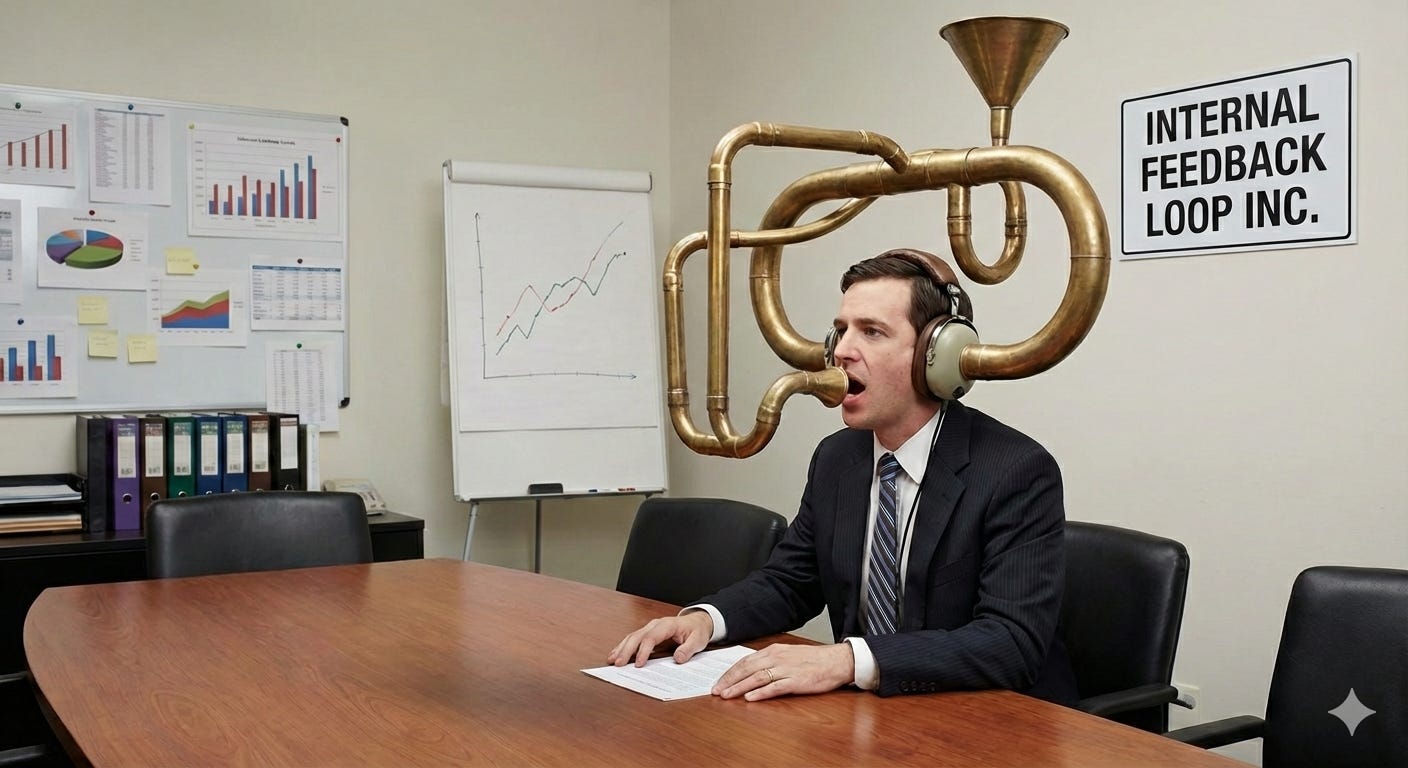
They have retreated from reality. They are operating on assumptions, templates, playbooks, and internal consensus. They have stopped doing the basic work of understanding what is actually happening outside their walls.
The intention question
In the age of AI, this “retreat” is accelerating. AI has made it easier than ever to produce polished work without doing the hard thinking underneath.
I’ve started asking a simple question to diagnose whether someone’s use of AI is healthy or destructive:
What is the intention?
Is the intention to get the job done, to close deals, to serve customers, to create something real? Or is the intention to look good, to sound smart in meetings, to produce polished decks that earn nods of approval, to have an answer ready even when you don’t understand the question?
The people who use AI to look good are the ones in trouble.
Their briefs sound sensible. Their presentations are coherent. Their positioning statements are articulate. But when you push them, when you ask, “Why will the customer care about this? What objection does this answer? What did the buyer actually say?”, they cannot answer. Because they did not do the listening.
They are not seeking closed deals. They are seeking nods of approval around the boardroom table. They are not seeking to understand the customer. They are seeking to appear informed. They are not trying to win. They are trying to survive the meeting.
These differences appear benign, but they run deep and the consequences are severe.
Companies staffed with people who listen inward will be outcompeted by those who listen outward. The ones who pick up the phone. The ones who sit with customers. The ones who hear what the market is actually saying before they build the campaign.
In an age where AI makes it easy to sound smart without doing the work, the competitive advantage belongs to those who actually do the work.
Why this matters to me personally
I’ve worked with countless tech companies around the world. And I’ve watched too many businesses struggle, not because the market was cruel, but because they stopped engaging with it.
The thing I keep coming back to is this: you don’t need to give up.
When someone’s business is struggling, when the pipeline is dry, when the economy feels hostile, they often feel like there is nothing they can do. They feel at the mercy of forces beyond their control.
But there is almost always something they can do. The problem is that the “something” requires direct engagement with reality. It requires listening, real listening, not AI-mediated summaries. It requires making calls when you don’t feel like it. It requires hearing hard truths from customers. It requires updating your assumptions instead of defending them.
That is work people avoid. And when they avoid it, they fail.
I want to change that. I want to reach people who are under revenue pressure and show them that there is a way forward. Specifically in the domain of sales and marketing, there are ways out of the slump. The skill that makes you resilient is the skill of listening: deep, disciplined, reality-connected listening.
That’s the mission I’m building toward.
The promise
Here’s the core idea, stated as simply as I can:
Everyone is worried about forces they can’t control. AI taking jobs. Recessions shrinking markets. Industries shifting overnight. The ground feels unstable.
The universal question is: How do I keep making money no matter what happens around me?
Power Listening is my answer. It is the skill that makes you resilient to environmental shocks, not by insulating you from your environment, but by connecting you to it so deeply that you can adapt faster than circumstances change.
While your competitors are automating their way out of touch with reality, you can own the market by actually hearing what people are telling you. While others panic at change, you adapt, because you heard it coming.
Power Listening is not a soft skill. It is not a passive, zen-type approach. It is a technically precise business and life skill. It takes action to get it right.
I don’t want to stop at the headline. I don’t want to assume you know what Power Listening means just because the words sound intuitive. In the posts ahead, I’m going to show you how to master this critical skill, step by step. With examples, methods, and cases.
That’s the thesis I’ll be testing, refining, and building in public over the coming months.
What comes next
This Substack will keep going. I’ll keep writing about sales, marketing, AI, and the mindset that makes rainmakers dangerous.
But now there’s a sharper focus underneath it all.
If you’ve been reading along and something has resonated, if you’ve felt the same frustration watching people retreat from reality, or if you’ve experienced the power of actually listening your way to a breakthrough, I want to hear from you.
Reply to this email. Tell me your story. Tell me what you’ve seen.
This is the beginning of something. Thanks for being here.
Make it rAIn, KG
Brilliant. This totallly reminds me of trying to really 'listen' to what my body is telling me during a tough Pilates session. Is your new thing an app or more of a framework?