


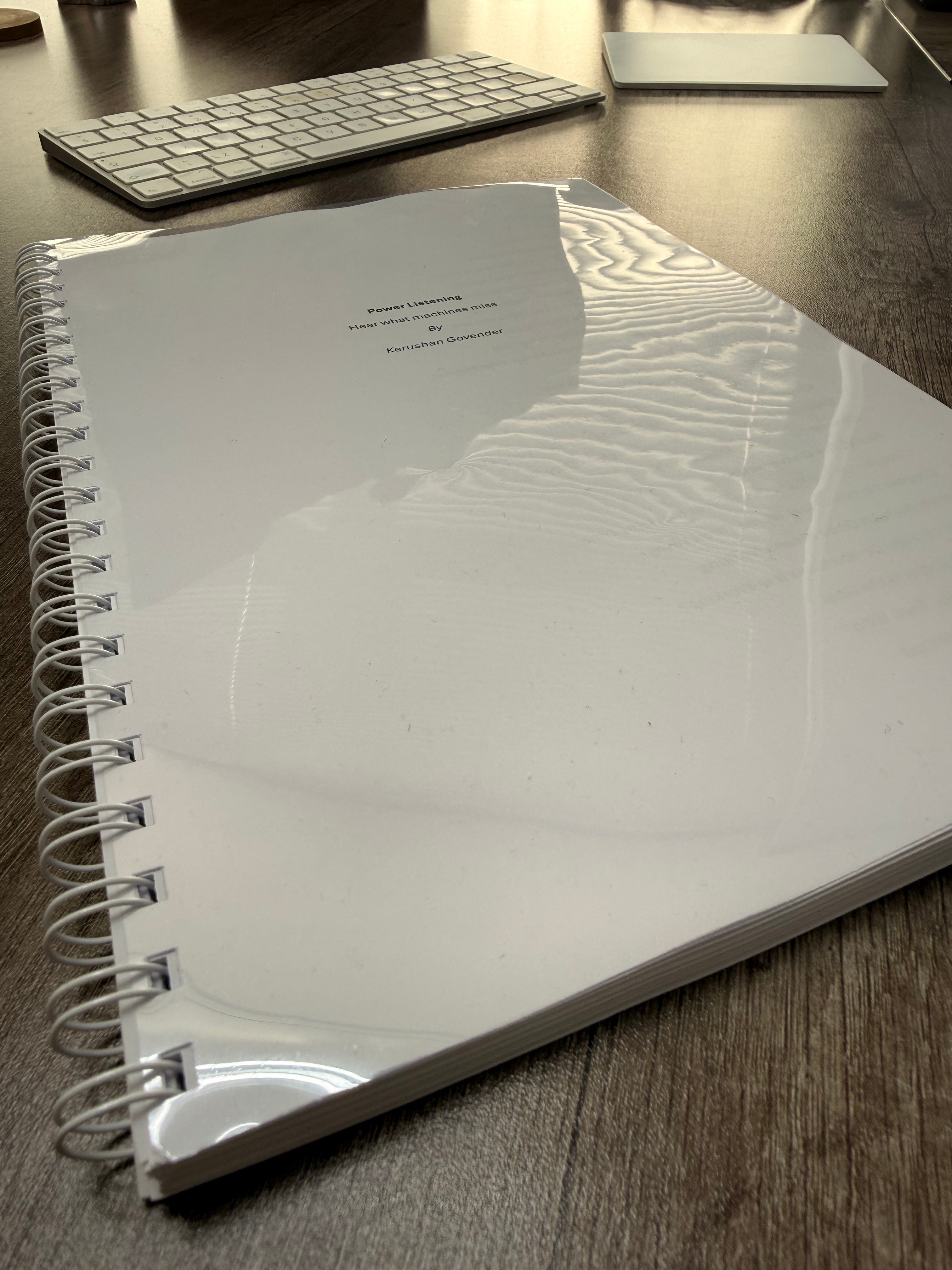
Last week I sent a finished manuscript to Wiley. Many months of writing, done.
Here’s the irony. I run an AI-forward agency. We use these tools every day, on real client work, with conviction. And I just finished writing a book about the one thing AI cannot do.
There is a danger I have started calling the automation of ignorance.
If that sounds like a contradiction from a pro-AI enthusiast, stay with me.
Consider the last few months.
In late May, Salesforce reported Agentforce at $1.2 billion in annual recurring revenue, up 205% in a year. In June, days apart, the same company filed its third round of layoffs in nine months. The agents are carrying quota. Some of the people who used to are carrying boxes.
At SaaStr’s AI Annual, Jason Lemkin described running SaaStr itself on three humans and roughly twenty agents. About $257 a month in agent costs, where half a million dollars of labour used to sit.
Every founder I speak to now has both slides in the deck. The agent slide and the layoff slide. The excitement and the dread, stapled together.
And underneath both, a stark set of numbers. The AI SDR tools that were meant to replace outbound teams are churning at 50 to 70% a year. Gartner expects more than 40% of agentic AI projects to be cancelled by the end of 2027. Meanwhile, Gong’s research across 7.1 million sales opportunities found that sellers who use AI generate 77% more revenue than sellers who do not.
Read those together and the story gets strange. AI-assisted humans are winning. Human-replacing AI keeps getting returned to the shop.
The market keeps asking whether the future belongs to agents or to humans. That is a spectator’s question. It fills conference panels and layoff headlines. It will not help you run your company.
The question that matters is hidden deeper. Where does the truth about your market come from?
Every use of AI in your business sits on one side of a line.
On one side sit your outputs. The drafts, the decks, the follow-up emails, the summaries of passing news, the consolidation of notes you took yourself. Delegate these freely. AI is magnificent here. This is where the 77% comes from.
On the other side sit your inputs. The customer interview, the win-loss call, the exact words a buyer uses to describe the problem that keeps her up at night. This is the raw material of judgment. It is where positioning, pricing and product decisions actually come from.
The line is simple to state and brutal to hold. AI belongs on your outputs. It must never replace your inputs. The manuscript puts it in two sentences, and I will stand behind them all year. AI without listening is automation of ignorance. Listening without AI is slow.
Four everyday cases, so this stays practical rather than poetic. A customer interview is foundational. Do it yourself, hear it yourself, never delegate the listening. On the contrary, industry news is fleeting. Summarise it with AI all day long. A competitor’s pricing page is foundational. Read the original, because the nuance is the intelligence. A follow-up email is an output. Let AI edit it happily, and check the facts.
I did not learn this from a webinar. I paid for it.
A while back at Blacfox we were under deadline on a campaign. We needed market feedback and there was no time, so we asked the machine to synthesise some. What came back was fluent, specific and completely plausible. It agreed with our strategy in the most articulate way.
We built the campaign on it. We launched. And nothing happened. No fireworks. Just silence.
In the post-mortem, someone finally said the difficult part. We had never actually spoken to anyone. The feedback was a remix of what the internet already believed, wearing the costume of our market’s voice.
This was not the AI’s hallucination. It was ours.
The cost to Blacfox was real. The spend, the weeks, our reputation, and the harder thing. We discovered how easy the retreat had become. The machine will proxy your market all day, fluently confirming what you already believe. It never gets tired. And it never says go and ask them.
Regular readers will recognise the shape of this failure. It is the same disease I described in earlier posts. Holding on when the evidence says let go, because the fiction is more comfortable than the market.
Here is the policy we adopted afterwards, word for word. Take it, paste it into your operating manual, and argue with me in the replies.
AI may touch: transcription of day-to-day meetings, consolidation, summaries of fleeting information, editing of outputs, formatting, scheduling, and analysis of data we gathered first-hand.
AI may never touch: the gathering. No synthetic interviews. No generated personas. No machine-written market feedback. No summary standing in for a foundational source. If a major decision depends on it, a human hears it in the original.
The manuscript that left my desk last week took deep introspection, because the inputs were gathered rather than generated. Hundreds of client conversations. Dozens of deals dissected. Decades of listening for a living.
So here is your Monday question, and mine. Look at everywhere AI touches your revenue engine this week and ask of each one, which side of the line is this on?
Where you find it standing between you and your market, move it. Aim it at your outputs, where it makes you faster. Keep your ears where they belong, close to the people who pay you.
Anything else is the automation of ignorance.
Make it rAIn, KG
PS: The book behind this argument lands from Wiley in February.