


Step Zero
Before you learn how to pitch, close, or handle objections, there’s a step that comes even earlier. Let’s call it Step Zero.
It happens before your first outreach. Before your first slide. Before you even open your mouth.
It’s this:
You’ve got to work things out in your head so that you’re not feeling like you’re selling.
This isn’t about acting confident. It’s not about tactics. It’s about how you view what you’re doing at a foundational level. Not faking confidence. Not trying to act “natural.” But actually arriving at a place where what you’re doing doesn’t feel manipulative, desperate, or transactional.
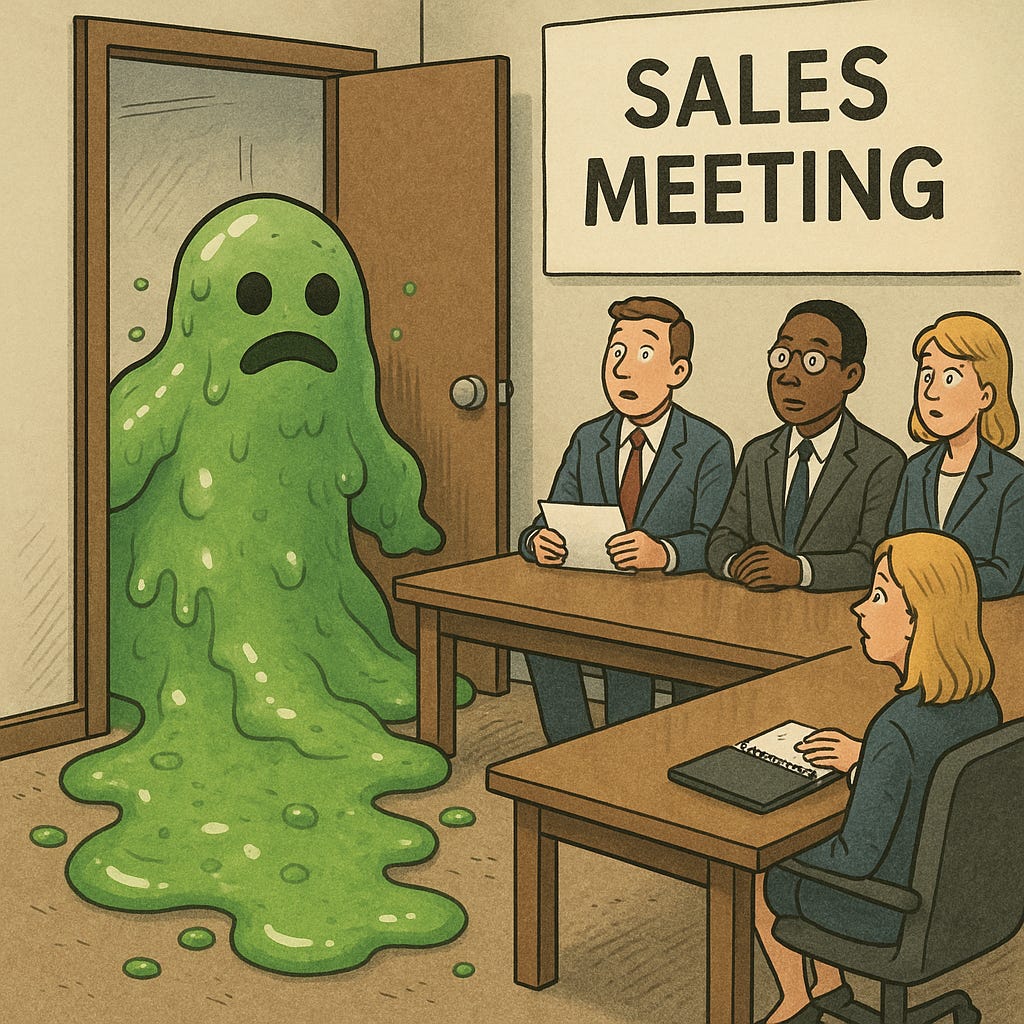
Until you recalibrate your internal script, everything else will feel like a performance. Once you do, selling shifts from something awkward to something natural. Even joyful. The hesitation dissolves. The slime factor? Gone.
Recommending What You Love
Think back to a time when you discovered a product or service that genuinely helped you. Something real. Something that made a tangible impact in your life.
You don’t keep it a secret, right? You tell your people. You recommend it—urgently, even—if you know they’re facing the same challenge. It’s not a “sales pitch.” It’s human. You’re being helpful.
That instinct, that natural reflex to share what works, is the very heart of authentic selling. Real sales and marketing comes down to this:
Sharing something you believe in, with someone who stands to benefit, at a time when it matters.
So before you worry about funnels or pitch decks, ask yourself:
Do I actually believe in what I’m recommending?
If the answer is no, stop. Because you won’t sell well, and worse, it will eat away at you. You’ll overcompensate with tactics. You’ll hesitate. You’ll feel like a fraud.
But when the answer is yes—yes, this product works, yes, this service solves a real problem—then you’re no longer just selling. You’re advising. You’re sharing. You’re saying, “This solved my problem. I know it can solve yours.” And that kind of belief is contagious.
When Belief Meets Boldness
When you believe in what you’re offering, you stop pushing and start guiding. You don’t need to be aggressive. But ironically, you can be assertive without ever coming across that way. Because your intention is clean.
That kind of belief unlocks boldness. Not the loud kind. The calm certainty that says, “You’d be crazy not to try this.”
And when that energy is behind your words, people listen. They might resist at first. But they feel the difference. You’re not manipulating. You’re standing for something. You’re advocating for what they need—sometimes even before they realise it themselves.
Story from the Trenches
A few years ago, I was selling Microsoft solutions and found myself in a meeting with a very senior government official in South Africa. The stakes were high—he had oversight over an entire jurisdiction.
He was polite. Respectful, even. But underneath the surface, I could tell: he was just trying to get through the meeting. Lots of nodding. Lots of agreement. But no real intent to act.
I could have accepted that and I was very tempted to. Many would have. His rank alone was enough to intimidate most. But I knew something he wasn’t acknowledging: his organisation was exposed, non-compliant, and drifting toward serious risk.
So I made a call. I dialled it up. I respectfully, but clearly, raised the urgency. I spoke plainly about what could go wrong and why this wasn’t something he could keep neglecting.
He didn’t take it well.
In fact, my worst nightmare as a professional became a reality in that instant. He told me to leave. In front of my peers. In front of people who reported to me. It was humiliating. And more than that, it was painful because I respected him.
But I stuck to my principle: do right by the customer, no matter what. And in B2B, “the customer” isn’t just the person in front of you. It’s the organisation. It’s the public they serve. It’s the long-term future.
So I told him, calmly and directly:
“If I walk out now, which, to be honest, is easier for us both, you’re going to stay non-compliant. You’re going to face trouble. But if you let me help you, this entire problem disappears—quickly. So let’s do this.”
To my surprise, he looked at me, paused, and simply said, “Okay. What’s next?”
Everything opened up from there.
That moment taught me something: belief backed by empathy is more powerful than status, protocol, or rank.
Selling Like a Parent
Let’s talk about another analogy—one I keep close.
Imagine a child is sick. Feverish. Fussy. The parent has medicine that will help. But the child refuses, throwing tantrums and raising hell.
A weak, neglectful parent gives in. A good, responsible parent finds a way to get the child to take the medicine, even if the road is long and tough.
Why? Two reasons:
They believe in the remedy. They know it works. They’ve seen it before. They trust the outcome. That belief gives them the confidence to act—even in the face of resistance.
They care about the child. It’s not about ego or control. It’s love. It’s responsibility. They’re thinking beyond the conflict, toward the outcome.
When belief and care converge, something powerful happens. You gain a new level of influence. You’re no longer pushing a product. You’re sincerely protecting the person from a bad consequence.
Don’t push to persuade. Push to protect.
Push because you’ve seen the outcome. Push because you care about the buyer’s future. Push because if you don’t, they might stay stuck.
True Empathy = True Influence
Great sellers and marketers don’t just "consider" the customer’s view. They inhabit it.
They leave their own world, with all its targets and tensions, and step fully into the buyer’s context. Not just to understand, but to feel what’s at stake for them.
That shift—from seller to advocate—is where influence multiplies.
It’s not about pretending you don’t have your own pressures. You do. We all do.
But when you can ignore your needs enough to serve someone else fully, you gain more than a deal. Not everyone has the power to transcend their own challenges. That’s why you gain respect. You gain trust. You gain permission to guide.
And weirdly? That’s when people start buying from you because of you.
The Slime-Free Close
So if selling has ever felt icky, manipulative, or awkward, here’s the reset:
Start with Step Zero.
Believe in what you’re offering.
Step into your customer’s world.
Advocate for what’s best for them.
Push only when it protects.
Sell like a good parent would. With clarity. With care. With conviction.
That’s not just how you close a deal. It’s how you earn a customer for life.
See you next Tuesday,
Kerushan
Brilliant!