


A hummingbird flaps its wings somewhere between fifty and eighty times a second. To pay for that, it drinks up to eight times its own body weight in nectar a day, feeding every ten to fifteen minutes through daylight. It carries the highest metabolic rate of any warm-blooded animal for its size. And when the sun goes down and the feeding stops, it cannot simply sleep the way you and I sleep. It drops into torpor, a controlled shutdown of its own metabolism, cutting its energy use by more than ninety per cent. Without that shutdown, the overnight fast would kill it.
All of that effort, and the bird barely flies anywhere. It simply holds a stable position over a flower.
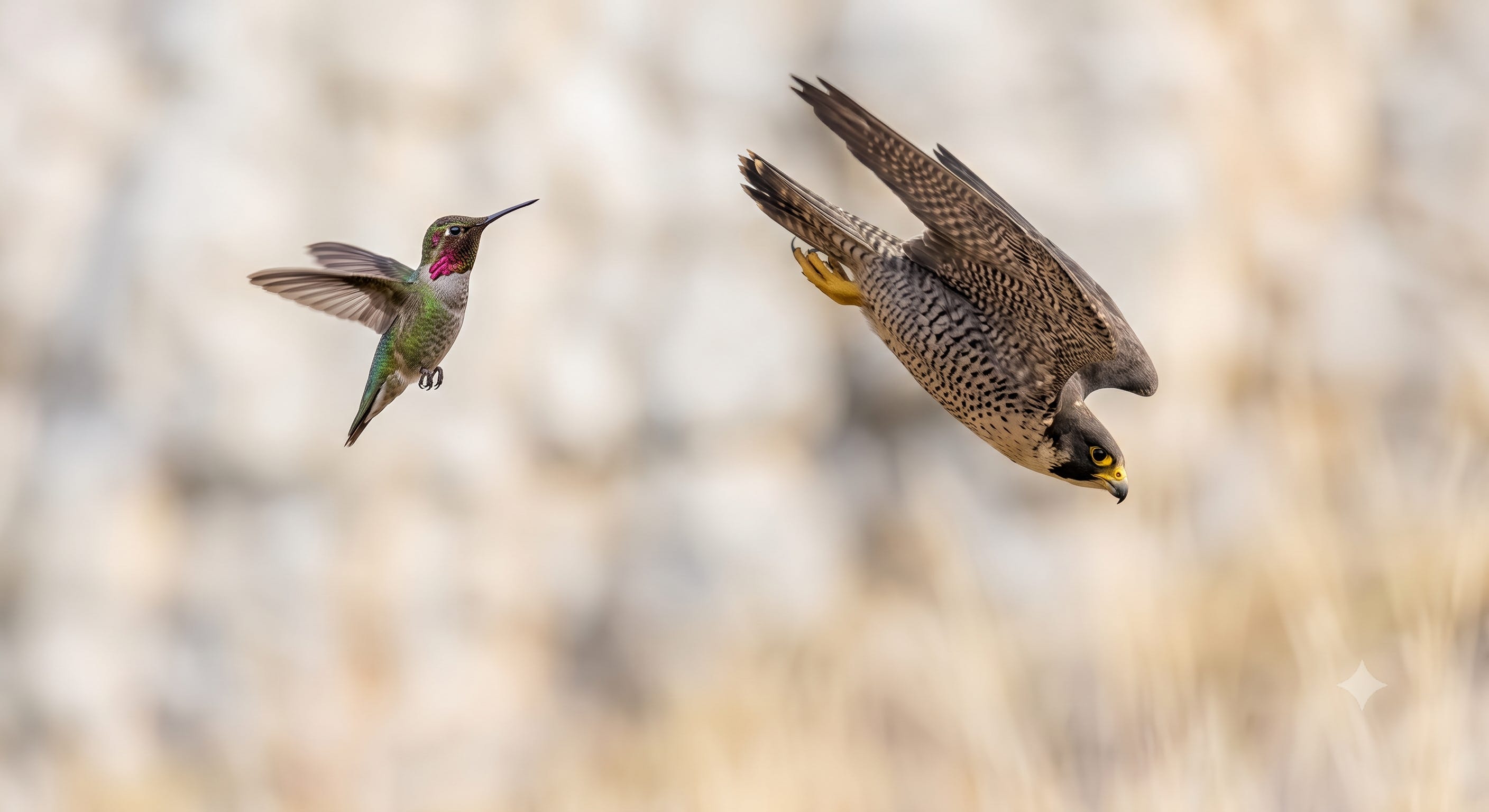
Hovering is one of the most energetically expensive things any animal does. Read that again, because it inverts something most of us assume. Staying in the same place is the most expensive flying there is.
We are born in mid air
Let’s carry this over into everyday life. Every morning you wake up with breath in your lungs, and the flapping starts. Just to stay where you are. The alarm goes off, the client wants the revision, the team needs a decision, the invoice has not been paid, the school run happens whether or not you slept. Even with no grand ambition at all, flap you must.
And the moment you stop, even briefly, you begin to descend. Life is unforgiving that way. A slight drop in getting things done and the nose dips. You feel it within days.
So a great deal of work buys you nothing but your current altitude. I find that fascinating, actually. It is also, I think, the source of a particular kind of exhaustion that people rarely name properly. They assume they are tired because they are not working hard enough. Often they are tired because they are working extremely hard at hovering.
Then there are the really bad days. The ones where there is little left to give. Where getting out of bed is a formidable task, and the ordinary daily grind feels beyond you. Being the static hummingbird is too much to ask. And a plummeting penguin is a far more appealing proposition. Deadlines slide. The to-do list goes unread. We will catch up tomorrow, we promise ourselves.
I wrote about those days in How to Cope When You Cannot, and the answer there still holds. The danger lies in doing nothing. Motion is the antidote. You only have to be operational, and then to do the next right thing after that. Fall to your knees if you must, but do it facing forward. On days like those, holding your position is the whole win, and you keep flapping one inch at a time.
Here is what I have made peace with. We are born in mid air. By virtue of being alive and breathing oxygen, we have inherited the duty of staying in flight. There is no reprieve.
And if you are managing to stay aloft without doing the flying, then someone is carrying you, as someone carried all of us when we were children. That is the plain truth of it.
You cannot dive from the ground
Now look at the falcon.
In 1999 a peregrine named Frightful, trained by the falconer Ken Franklin, was released from a light aircraft at seventeen thousand feet and clocked at 389.46 kilometres per hour on the way down. That still stands as the Guinness record for the fastest bird in a dive. A wild peregrine hunting on the wing is generally reckoned to hit around 320 kilometres per hour in its stoop.
It is the most admired moment in the animal kingdom, and it cost the bird almost nothing. It folds, and gravity does the rest.
But watch what has to happen before.
A falcon cannot dive from the ground. To reach those speeds it has to be high, often a thousand feet up and frequently much higher. It earns that height the way an eagle does. Wings held out, riding thermals, the columns of warm air that rise when the sun heats the ground. Soaring costs a large bird only two or three times its basal metabolic rate. Flapping costs a great deal more, and the gap widens the heavier the bird gets.
And thermals are invisible. Before the falcon can ride one, it has to find it, by reading the ground below, the heat coming off it, the way other birds are drifting.
So the fastest animal on earth spends most of its hunt doing something slow. It reads the air. It climbs cheaply. Only when it locks into a target does it dive, at fascinating speeds.
Then there is the hummingbird. Fifty to eighty flaps a second, and it never gains a single foot of height. It works harder than the falcon ever does, and pays full price all day for nothing.
Aimless effort is the expensive kind
This is the part I want you to take away.
If life feels like a grind, the instinct is to conclude that you need more energy. More discipline. More hours. An earlier alarm. And sometimes that is true. But the quantity of effort is rarely the whole story. The bigger cost is that there isn’t a clear goal or target. The effort has no direction to organise itself around, and undirected effort is far more expensive than directed effort.
Think about what scrambling actually costs you. You start three things and finish none, so you pay the setup cost three times and collect the reward zero times. You reprioritise on Tuesday and again on Thursday, so Wednesday’s work is wasted. You take a meeting because it was offered, then take the follow-up because you took the first one. Nothing compounds. Every day starts from a standstill.
That is hovering.
Now give that same person one named goal and watch what changes. The three tasks become one task. You stop swapping priorities midweek, because you already know what counts. The meeting invitation gets declined in nine seconds, because it plainly does not serve the goal. Same person, same energy, and the day suddenly costs less to run.
That is the irony at the centre of this. Flying forward toward a goal at speed can be less tiring than hovering aimlessly.
So that is what a goal is for. It exists to make your effort cheaper by giving it somewhere to go. The same is true of the revenue target handed down to you from above, even though that one is harder to love.
How the height gets earned
Now back to the climb, because that is the part closest to everything I write about here.
The falcon’s altitude comes from attention. The thermal is already there, invisible, and the bird either reads it or misses it. Read it right and you rise. Read it wrong and you are back to flapping.
That is the chain I keep coming back to. Income follows value. Value follows understanding. Understanding follows listening.
This means the market will tell you where the growth is, and your job is to notice. Your own life works the same way. Success comes from paying attention to what is already in front of you and using it to achieve your goal.
Aim without attention is a fast way to arrive somewhere you did not want to be.
The drill
So, practically. If you are hovering and it is grinding you down, start with direction, and take that direction from the evidence in front of you.
1. Name one thing. One target, far enough out to be worth diving for, close enough that you can picture the day it happens. Write it as a sentence with a number in it. “Grow the business” is vague. “Three new retainer clients by the end of November” is a target.
2. Attach a date. Without a date it is a wish, and a wish will not help you decline a meeting.
3. Run the week against it. On Friday, look back and mark each significant block of your week: did this move the goal, hold altitude, or cost me height? Most people find their first honest week is mostly the middle column. That is fine.
4. Cut one hovering activity. One recurring thing that keeps you exactly level and takes real hours. Kill it, hand it over, or shrink it. You are buying fuel.
That is it. Four steps, and the first one does most of the work.
So which bird are you
Two birds, and only one of them is the answer.
The hummingbird never climbs and never aims. It burns more energy per gram than almost anything alive and ends the day exactly where it started. That is the trap, and most of us are in it more often than we admit.
The falcon is the one to be, for a reason people usually miss. Everybody wants the dive. Nobody wants the climb. And the dive stays out of reach until the climb is done, because you cannot dive from the ground.
Pay attention first, until you can see where the growth actually is. Climb on it, cheaply, while everyone around you is flapping. Then pick your target and commit, and let the height you earned do the work.
There is no shame in hovering. On the hardest days, hovering is the win. But if hovering has become permanent, and flapping harder is the only answer you have left, something’s got to give.
Read the scene. Earn the height. Then find something worth diving for.
Make it rAIn, KG